
Tesamorelin is a synthetic version of growth hormone-releasing hormone, a signal your brain normally sends to prompt the pituitary gland to release growth hormone. The only formal approval for it is for reducing excess belly fat in adults with HIV who have lipodystrophy, and the peer-reviewed literature built around that use is where the strongest evidence lives. Researchers who work with compounds like Kylo tesamorelin typically start with that body of trials before looking at anything newer.
So what do the studies actually say? Randomized trials in that approved population consistently show reductions in visceral fat, the deep abdominal fat surrounding organs. Findings in other areas, including liver fat, cognition, and body composition in people without HIV, are earlier-stage and far less settled. We’ll keep those two categories clearly separate throughout this summary, because blending them is how research gets overstated.
One thing deserves saying up front. None of the research covered here directly addresses limb loss, amputation, or prosthetic use. If you’re a person living with limb loss, a family member, or a rehabilitation professional, we won’t suggest otherwise. What we can offer is a clear, plain-language look at the science, the way award-winning journalist Andy Tiessen approaches complex topics: respect the reader, skip the hype, and let the evidence set the limits.
We’d also like to hear from you. Tell us in the comments what questions you’d want answered about peptide research.
What Tesamorelin Means: A Plain-Language Definition
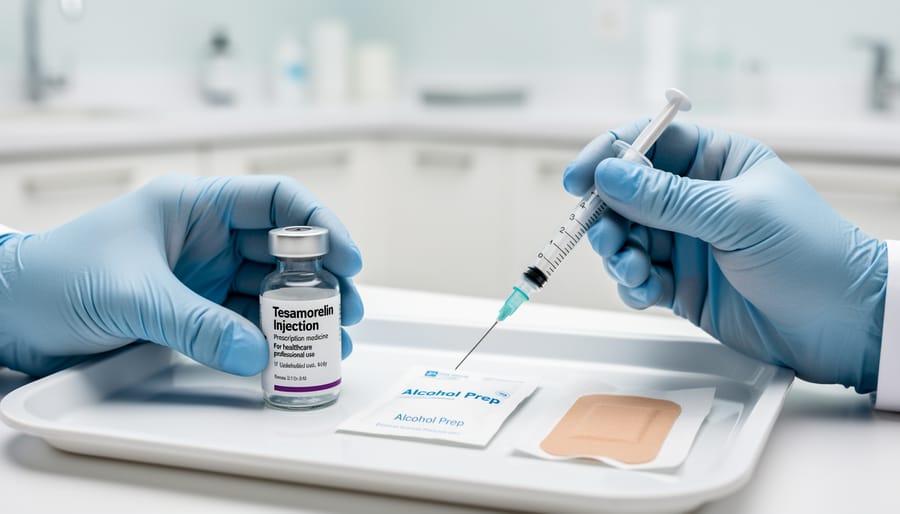
Tesamorelin is a prescription medicine, given by injection, that is a lab-made copy of a hormone your body already produces. That hormone is growth hormone-releasing hormone, or GHRH. Think of GHRH as a message sent from the brain to the pituitary gland, a small gland at the base of the brain, telling it to release growth hormone. Growth hormone then helps regulate how the body builds tissue, uses energy, and stores fat.
Tesamorelin is called a synthetic analog because it is made in a laboratory to closely resemble natural GHRH, with a small structural change that helps it last longer in the body. It is given as a daily injection under the skin, usually in the abdomen.
In the United States, it is approved by the FDA for one specific purpose: reducing excess abdominal fat in adults with HIV who have a condition called lipodystrophy. Researchers have studied it in other groups too, but those studies do not change what it is approved for. Using a medication for something outside its approved purpose is called off-label use, and that is a decision for a person and their physician together.
Here are a few terms you will see throughout this article:
- Tesamorelin
- A synthetic version of GHRH, given as a daily injection under the skin, approved for a specific type of abdominal fat reduction.
- Growth hormone-releasing hormone (GHRH)
- A natural hormone that signals the pituitary gland to release growth hormone.
- Visceral adipose tissue (VAT)
- Fat stored deep inside the abdomen, around organs such as the liver and intestines, rather than just under the skin.
- IGF-1
- A substance the liver makes in response to growth hormone, often measured in blood tests to see how active the growth hormone system is.
- Lipodystrophy
- A condition in which the body stores or distributes fat abnormally, sometimes causing fat to build up in the belly.
- Off-label use
- Using an approved medication for a purpose, dose, or group of people not listed in its official approval.
With these definitions in hand, the research summaries ahead should be easier to follow.
How Tesamorelin Works in the Body
Tesamorelin works by sending a signal, not by supplying the hormone itself. It mimics the body’s natural growth hormone-releasing hormone (GHRH), which travels to the pituitary gland, a small gland at the base of the brain. When tesamorelin reaches the pituitary, it prompts the gland to release the body’s own growth hormone in natural pulses.
That release matters because growth hormone, in turn, nudges the liver to make more IGF-1, a hormone that helps regulate how the body builds tissue and handles energy. Together, these signals can shift how the body stores and burns fat. This is also a key difference from injecting growth hormone directly. Because tesamorelin works through the pituitary, the body’s built-in feedback controls stay involved, which means growth hormone rises and falls in a more natural rhythm rather than staying elevated around the clock.
So why the focus on fat deep inside the abdomen? Researchers distinguish between subcutaneous fat, which sits just under the skin, and visceral fat, which wraps around organs like the liver and intestines. Visceral fat is more metabolically active and has been linked to heart and blood sugar concerns, so it became the natural target of study. Findings in the published literature center on changes in this deep abdominal fat, not on how much a person weighs overall. That distinction helps explain why tesamorelin is not considered a general weight-loss tool.
What the Published Research Has Found
Reducing Visceral Abdominal Fat: The Core Evidence
The strongest evidence for tesamorelin comes from two large phase 3 trials in adults living with HIV who had developed excess fat around the abdomen, a condition often linked to long-term antiretroviral therapy. Both studies were randomized and placebo-controlled, meaning participants were assigned by chance to receive either tesamorelin or an inactive injection, and neither they nor the researchers knew which was which. That design is the gold standard for separating a real treatment effect from coincidence.
Participants were treated for about six months, and the main measurement was visceral adipose tissue, the fat stored deep inside the abdomen around the organs. It was assessed with imaging, typically CT scans, rather than relying on waist size alone. Across these trials, people receiving tesamorelin showed a meaningful reduction in visceral fat compared with those on placebo, while fat just beneath the skin changed very little. Some studies also reported modest improvements in how participants perceived their own abdominal size and body image. Together, these findings supported regulatory approval for this specific use.
One finding deserves equal attention. In follow-up phases where some participants stopped tesamorelin, visceral fat tended to return toward baseline levels. This suggests the effect depends on ongoing treatment rather than producing a permanent change, which is an important point when weighing benefits and long-term commitment with a clinician.
It’s also worth keeping the scope clear. These trials enrolled a particular group of adults, so their results don’t automatically apply to everyone. For exact numbers, trial sizes, and measurement details, the original published papers and your healthcare provider are the best sources.
Metabolic and Body Composition Findings Beyond Belly Fat
Researchers have looked at more than belly fat, and the picture here is less uniform. In the pivotal trials, people taking tesamorelin often saw improvements in blood fat measures, especially triglycerides, which tended to fall compared with placebo. Results for total cholesterol and non-HDL cholesterol were smaller and less consistent from study to study, so it’s fair to call those findings modest rather than dramatic.
Lean body mass is another area worth reading carefully. Some studies reported small increases in measures of muscle or trunk lean tissue, which fits with what raising growth hormone and IGF-1 might be expected to do. But gains were generally modest, and they weren’t shown to translate automatically into better strength or function. That distinction matters for anyone thinking about mobility.
Glucose findings call for the most caution. Because growth hormone can affect how the body handles sugar, researchers monitored fasting glucose and related measures closely. Across the literature, results were mixed: some trials showed little change overall, while others noted small shifts in glucose or insulin markers in some participants. This is one reason ongoing monitoring is part of treatment.
There is also early-stage work on liver fat. A smaller body of research has explored whether tesamorelin could reduce fat stored in the liver in people with conditions such as fatty liver disease. These findings are emerging, based on limited studies, and shouldn’t be read as established benefit. The original papers, and your clinician, are the best sources for exact figures and what they mean for you.
Emerging and Exploratory Areas of Study
Beyond the core trials, researchers have looked at tesamorelin in smaller, earlier-stage studies. Some have explored whether raising growth hormone signaling might support thinking and memory in older adults, including people with mild cognitive changes. Others have examined liver fat and metabolic health in different groups. These studies are often small, short, or still waiting on larger follow-up work, so they point to questions worth asking rather than answers.
Here is a quick way to sort the evidence by strength:
- Well-studied: reducing excess visceral belly fat in adults with HIV-associated abdominal fat accumulation.
- Early-stage: liver fat reduction, including in fatty liver disease.
- Early-stage: cognition and aging-related research in older adults.
- Not yet studied: limb loss and mobility-limited populations.
That last item matters for this community. No published literature we reviewed establishes tesamorelin as a treatment for limb loss, muscle loss from reduced mobility, or related conditions. Until studies in those groups exist, any claim that it helps is a hope, not a finding.
Early results also tend to look stronger in small samples than they hold up in larger ones. If you’re curious about any of these emerging areas, treat them as conversation starters with your healthcare provider, who can weigh your own health history and point you to the original studies.
Safety, Side Effects, and Who Should Be Cautious

Like any prescription medication, tesamorelin comes with a documented safety profile, and the published trials describe it fairly consistently. Most side effects reported were mild to moderate, and many people in the studies completed treatment without serious problems.
The most commonly reported effects include redness, itching, or irritation where the injection is given. Some participants also noticed joint discomfort or stiffness, swelling in the hands or legs, and muscle aches. If you already live with chronic discomfort, it helps to talk through your existing pain management options with your clinician before starting anything new, so new aches aren’t mistaken for old ones.
Because tesamorelin prompts the body to make more growth hormone, it can raise IGF-1 levels and affect blood sugar. Studies tracked glucose and IGF-1 closely for this reason, and some participants saw changes in glucose measures. That is why regular lab work is a standard part of care, and why anyone with diabetes or prediabetes needs especially careful follow-up.
Certain groups are generally advised not to use it. These include people who are pregnant, since there’s no benefit and a potential for harm, and people with active cancer or a history of certain tumors, particularly those affecting the pituitary gland, because growth hormone pathways can influence tumor growth. People with known allergies to tesamorelin or its ingredients should also avoid it.
None of this is a reason for alarm, but it is a reason for partnership. A healthcare provider can review your history, order the right tests, and spot problems early. Decisions about any medication belong with you and your care team, not with a summary article.
How Tesamorelin Is Used, and What It Means for the Disability Community

Tesamorelin has one approved clinical use: reducing excess abdominal fat in adults with HIV who have lipodystrophy. Treatment is typically a once-daily injection under the skin, prescribed and monitored by a physician, with regular checks on blood sugar and IGF-1 levels. Because belly fat tends to return after treatment stops, doctors usually review progress over time rather than treating it as a one-time fix.
So what does this mean for the disability community? Honestly, the research doesn’t speak to limb loss directly. No published studies establish tesamorelin as a treatment for mobility-related conditions. But the concerns behind the curiosity are real. Reduced activity after limb loss or with mobility limitations can shift body composition and affect metabolic health. Those are fair things to raise with your doctor.
You can start that conversation by asking about your weight distribution, blood sugar, cholesterol, and energy levels, and whether any testing makes sense for you. Bring your questions, and be clear about your goals.
Meanwhile, the foundations matter most. Getting proper nutrition supports energy, healing, and weight management. Adaptive fitness and physical therapy build strength and keep you moving, and a few home gym tools can make consistent training easier on your own schedule. And if discomfort is limiting your activity, exploring phantom limb pain solutions with your care team may help you stay active.
Award-winning journalist Andy Tiessen often reminds readers that the best health decisions come from informed, honest conversations with your care team, not from chasing the latest headline.
Have you talked with your doctor about body composition or metabolic health? Share your experiences with our community. Your story may help someone else ask the right question.
Questions Readers Often Ask About Tesamorelin Research

Is tesamorelin a weight-loss drug?
No. It has been studied for reducing visceral fat, the fat stored deep around the organs, rather than for lowering overall body weight. Talk with your healthcare provider about what realistic goals look like for you.
Is it the same as growth hormone?
Not quite. Tesamorelin is a synthetic version of GHRH, which prompts the pituitary gland to release your body’s own growth hormone, rather than supplying growth hormone directly.
Is it approved for people without HIV?
The approved use is for excess abdominal fat in certain adults with HIV. Research in other groups is still developing, and using it for any other reason would be considered off-label.
What happens when treatment stops?
In the pivotal trials, visceral fat tended to return after treatment ended. Your provider can explain what that might mean for you.
A couple more questions come up often. Can tesamorelin help with mobility or muscle loss? The published literature does not establish it as a treatment for either, and nothing in the research directly addresses limb loss. Nutrition, adaptive fitness, and physical therapy remain well-supported ways to build strength and maintain function.
Where can you read the original studies? Free databases like PubMed list the trial reports and review articles, and many include plain-language abstracts. Reading the source material yourself is a good habit, since a summary like this one can only point you in the right direction. Bring what you find to your care team so you can talk through what applies to your situation.
It’s also worth asking early about cost. Since tesamorelin is a prescription medication with a specific approved use, insurance coverage can be a real hurdle, and understanding the process up front can save you stress later.
The published research on tesamorelin gives a fairly clear picture in one area and a much hazier one everywhere else. The strongest evidence comes from randomized, placebo-controlled trials in adults with HIV-associated abdominal fat accumulation, where treatment reduced deep belly fat and that benefit faded once treatment stopped. Findings on cholesterol, triglycerides, lean mass, liver fat, and cognition are earlier and mixed, and they point to questions still being asked. No published work here establishes tesamorelin as a treatment for limb loss or mobility-related conditions.
Tesamorelin is a prescription medication with a defined clinical role, and it needs a provider’s oversight. If body composition, metabolic health, or changes in activity are on your mind, you don’t have to sort through the studies alone. Bring what you’ve learned to your care team, ask what the evidence means for your situation, and weigh it alongside nutrition, adaptive fitness, and physical therapy.
You know your body and your goals best, and good questions are a strength. If you’ve had conversations with your doctor about these topics, or you’re still working out what to ask, share your experience or your questions with our community. Someone else is probably wondering the same thing.